135th Turning Pages Book Club Session: Nyanza Meets North Sudan
There are moments when a book club session quietly transforms into something else—something you don’t quite plan for.
Today was one of those moments.
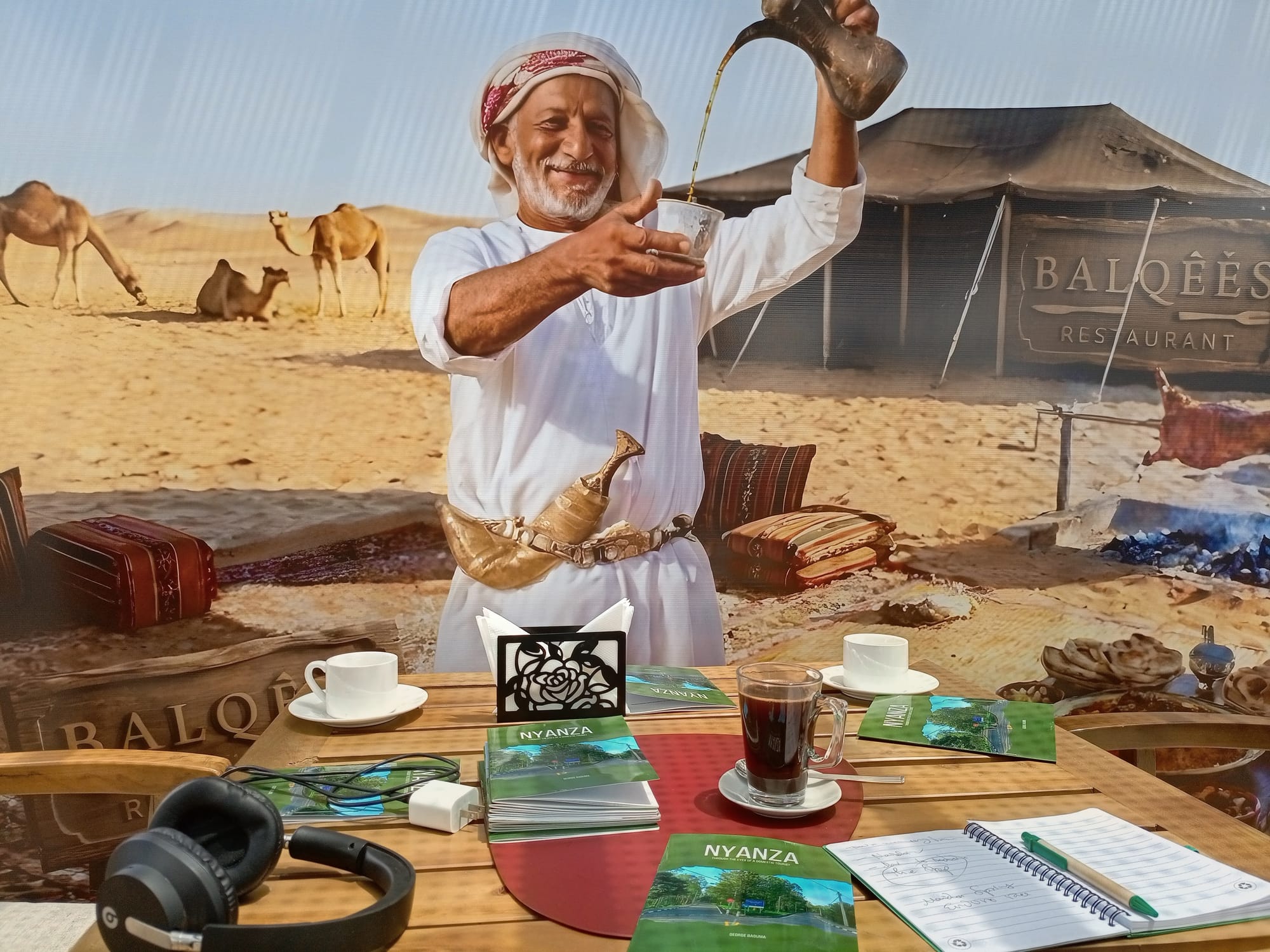
We gathered for a hybrid Turning Pages session, blending in-person and virtual participation. The setting was Balqees Restaurant, but the atmosphere stretched far beyond Kigali. The table itself told the story before we even began.
Set against a desert backdrop, an Arab man poured Sudanese coffee into a small cup—slowly, deliberately. Behind him, camels wandered across the sand. In front of that scene, copies of Nyanza: Through the Eyes of a Domestic Tourist rested on the table. A Rwandan story placed within a Sudanese frame.
And just like that, the session had its tone.
As we sipped the coffee, the conversation followed the path laid out by the book—into Nyanza District, into the heart of Rwanda’s pre-colonial kingdom. We spoke of structure, order, and the quiet precision that defined a centralized system long before colonial disruption.
But the discussion didn’t stay within Rwanda’s borders.
The participants—young Sudanese pursuing their education in the Land of a Thousand Hills—naturally drew parallels. Questions turned into comparisons. Observations became bridges. What began as a reflection on Nyanza evolved into a dialogue between histories, between cultures.
Somewhere along the way, the session stopped being about a book.
It became an exchange.
We were, in a sense, taking Nyanza to Sudan—placing it on the table, opening it up, letting it travel through conversation. But at the same time, we were receiving something in return. Through the coffee, the perspectives, and the shared curiosity, Sudan found its way into the discussion just as deeply.
In the end, it was clear: this was never just about reading.
It was about connection.
And sometimes, all it takes is a table, a cup of coffee, and a story—to bring two worlds into the same room.