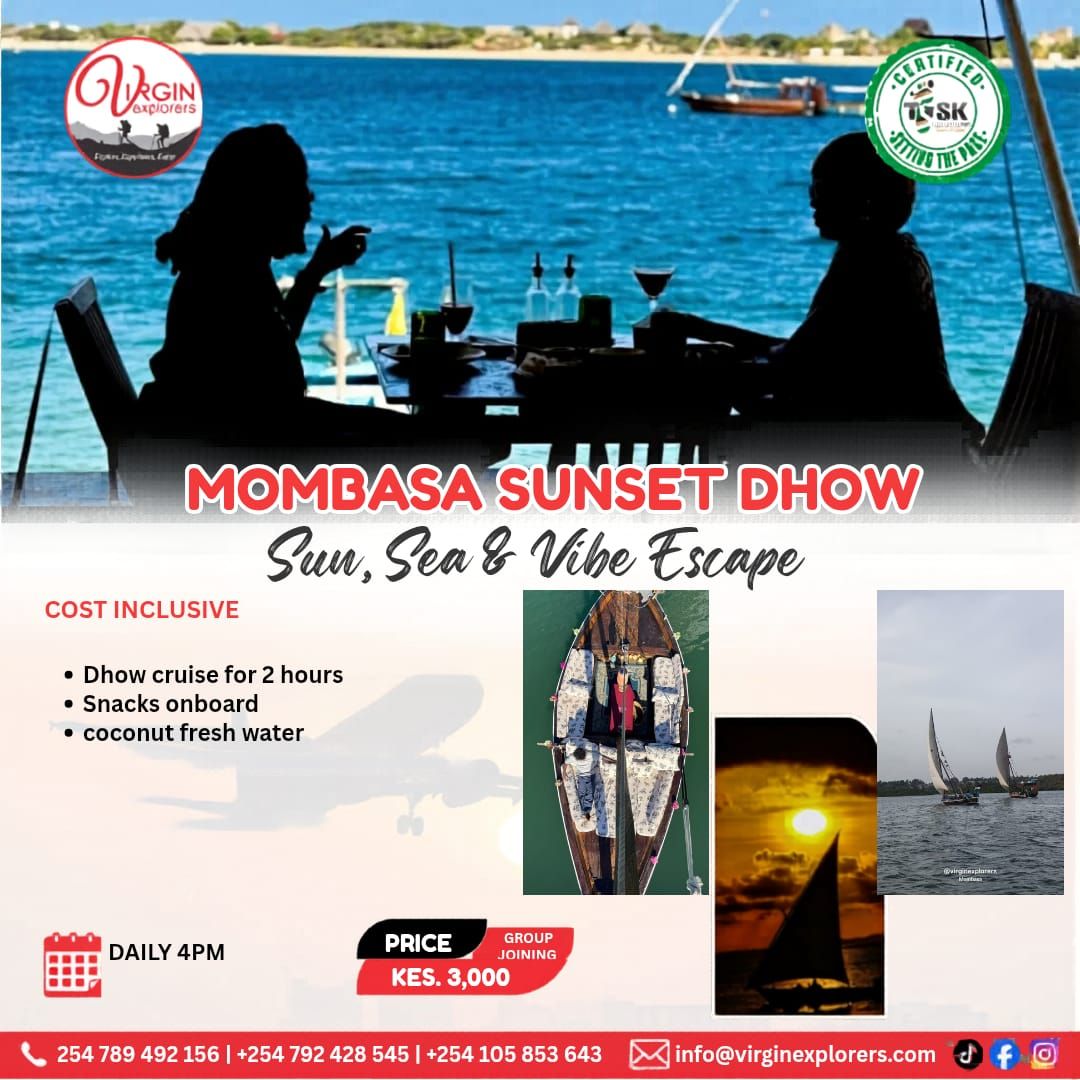
Sunset Dhow Experience with Virgin Explorers
Once the workhorses of Indian Ocean trade, dhows carried goods, stories, and cultures along the East African coast and beyond. To some extent, they still do. In places such as Mombasa, however, they have also taken on a new role. These wooden vessels, shaped by centuries of seafaring tradition, now offer a slower and more reflective way to experience the ocean.
You do not rush on a dhow. You ease into the journey, moving gently across the water and discovering the coastline not simply as a destination, but as a feeling.
During my stay in Mombasa, I enjoyed a memorable dhow experience courtesy of Virgin Explorers.
I boarded at English Point Marina Hotel, stepping onto a dhow that was already occupied mostly by domestic tourists. In fact, I was the final passenger to board.
The atmosphere was pure bliss. There was an easy calm in the air. Nothing felt forced, and nothing felt rushed. Conversations flowed lightly, laughter rose and faded, and everything seemed to move at its own pace. It was the kind of setting that invited me to settle in, lower my guard, and simply be present.
Although the vessel was traditional and rooted in the longstanding maritime culture of the Indian Ocean, its interior told a slightly different story. Modern design blended with quiet simplicity, creating the feeling of a minimalist open air lounge.
Before stepping aboard, I removed my shoes and placed them in a designated compartment. Going barefoot deepened the sense of relaxation. It made the experience feel more grounded and more connected to the water beneath us.
As I settled in, I noticed the crew preparing refreshments. They chopped open madafu, young coconuts served in their natural form. Before long, we were sipping fresh coconut water as live drumming filled the dhow.
The drummers performed Swahili songs popular along the East African coast. Their music created a rhythm that carried through the entire experience.
From English Point, we sailed smoothly toward Tudor Creek. Early in the journey, the waterway narrowed, allowing me to observe two very different sides of Mombasa at once.
On one side stood Old Town, with its centuries old buildings appearing almost frozen in time. On the other side, modern Mombasa rose with a completely different energy. The contrast captured the character of the city perfectly. The old and the new existed side by side, each contributing to Mombasa’s identity.
At some point, I joined the drumming troupe.
I picked up a drum and played along. I sang as well. The familiar Swahili songs transported me back to my time in Dar es Salaam many years earlier. Memories surfaced naturally, carried by rhythm, language, and familiarity.
Eventually, I put the drum down and stepped away.
I stood quietly, sipping coconut water and watching the city unfold on both sides of the channel surrounding the island.
Mombasa was beginning to make more sense.
The heart of the city is an island. Moi International Airport, my point of entry, is situated on the western mainland, while my hotel was located along the beach on the northern mainland. After landing, I had been driven through the island, entering through Makupa Bridge and leaving through Nyali Bridge.
Now, aboard the dhow, we sailed beneath both bridges.
That moment connected everything. The journey was not merely scenic. It was also clarifying. It helped me understand the geography of this uniquely shaped city in a way that travelling by road had not.
Then came the highlight of the experience.
Sunset.
The engine was switched off, and the dhow slowed into a gentle drift. A deep stillness settled over the water.
The sunset unfolded gradually, with colours stretching across the sky as daylight gave way to evening. There was no rush and no noise. The moment did not demand attention, yet it held mine completely.
As we drifted through the fading light, everything seemed perfectly aligned. The setting, the music, the water, and the rhythm of the experience came together effortlessly.
This was more than a cruise.
It was a different way of seeing Mombasa.